
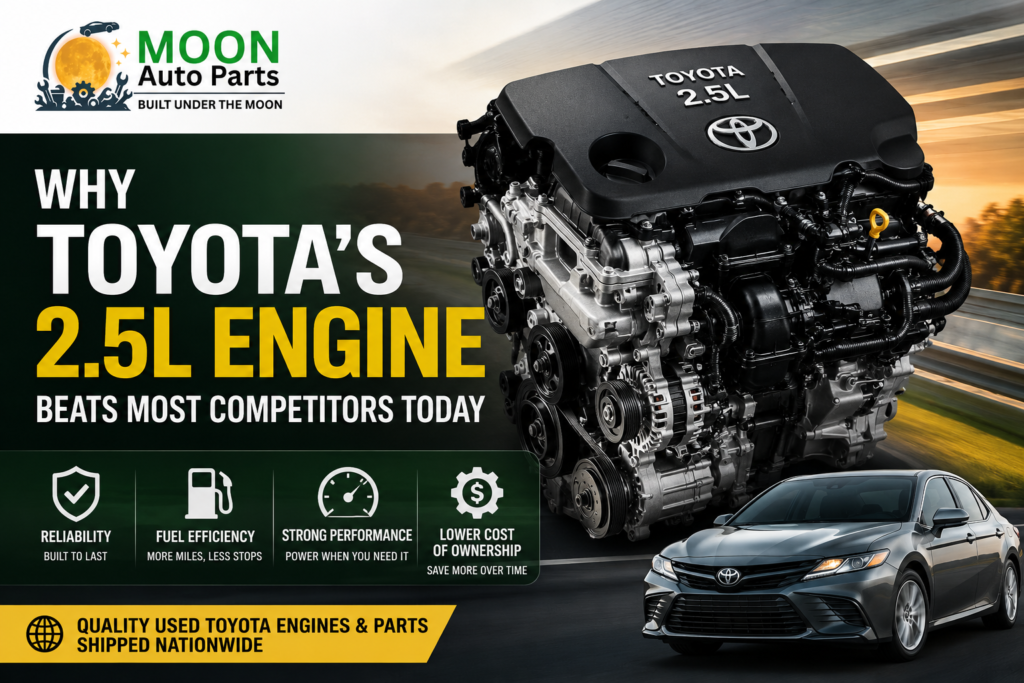
When it comes to dependable, efficient, and long-lasting engines in the mainstream automotive segment, Toyota’s 2.5-liter four-cylinder stands in a class of its own. Whether you’re shopping for a daily commuter, a family SUV, or a fuel-sipping hybrid, this engine has quietly become one of the most trusted powerplants on American roads. Here’s why it continues to outclass the competition year after year.
What Makes Toyota’s 2.5L Engine So Popular in the U.S.?
Toyota’s 2.5L engine officially part of the Dynamic Force family has earned a devoted following among American drivers for several compelling reasons.
Strong reliability ratings. First and foremost, Toyota consistently ranks at the top of J.D. Power and Consumer Reports reliability surveys year after year. The 2.5L engine is a central reason why. Because of its naturally aspirated design, there are fewer turbocharger-related failure points, fewer sensors to fail, and less heat stress on internal components.
Excellent fuel economy. In hybrid configurations, the 2.5L delivers extraordinary efficiency — the Toyota Camry Hybrid achieves up to 51 MPG combined, while the RAV4 Hybrid hits around 40 MPG combined. Even the non-hybrid versions consistently deliver 28–35 MPG on the highway, making it one of the most fuel-efficient naturally aspirated engines in its class.
Smooth daily driving performance. Unlike turbocharged rivals that can feel “on-or-off” with their power delivery, Toyota’s 2.5L offers predictable, linear acceleration. There’s no turbo lag to manage, no sudden power surges — just responsive, confidence-inspiring performance whether you’re merging onto a freeway or navigating stop-and-go city traffic.
Lower long-term maintenance costs. With no turbocharger to replace, no intercooler to maintain, and a simple, proven architecture, the 2.5L costs noticeably less to own over 100,000+ miles compared to many turbocharged competitors. Owners regularly report going years without any significant repair bills.
Which Toyota Vehicles Use the 2.5L Engine?
The 2.5L engine powers some of Toyota’s most popular and best-selling vehicles in the U.S. market.
Toyota Camry
The Camry has long been America’s best-selling car, and the 2.5L is the heart of that success. In its standard form, it produces 203 horsepower. In the Camry Hybrid, the combined system output climbs to around 208 horsepower while dramatically improving fuel economy.
Toyota RAV4
The RAV4 is America’s best-selling SUV, and the 2.5L engine is a key reason why. The standard RAV4 uses a 2.5L producing 203 hp, while the RAV4 Hybrid pushes combined output to 219 hp — all while delivering SUV-class efficiency that competitors struggle to match.
Toyota Highlander
In the three-row Highlander, the 2.5L works within a hybrid system to produce a combined 243 horsepower. This setup manages to move a full-size family SUV while achieving an EPA-estimated 36 MPG combined in the hybrid variant — a figure that turns heads in the segment.
Toyota Crown
The Toyota Crown, reborn as a bold, sporty crossover, uses a 2.5L hybrid powertrain to produce 236 combined horsepower. It pairs striking styling with the proven efficiency and reliability that Toyota’s 2.5L is known for.
Lexus ES 250
Lexus, Toyota’s luxury arm, uses a variant of the 2.5L in the ES 250 sedan. Here it produces 203 horsepower and is tuned for a quieter, more refined character befitting a near-luxury sedan — proving the engine’s versatility across market segments.
How Much Horsepower Does the Toyota 2.5L Engine Produce?
Standard horsepower range. In naturally aspirated form, the Toyota 2.5L Dynamic Force engine produces 203 horsepower and 184 lb-ft of torque across most applications, including the Camry and RAV4. This is competitive for a naturally aspirated four-cylinder and delivers ample power for everyday driving.
Hybrid performance figures. When paired with Toyota’s Hybrid System II, output climbs significantly. The RAV4 Hybrid delivers 219 combined hp, the Highlander Hybrid 243 hp, and the Crown 236 hp. These figures make the hybrid variants genuinely quick for their segments — the RAV4 Hybrid, for instance, does 0–60 mph in around 5.8 seconds.
Torque and acceleration details. The 2.5L produces 184 lb-ft of torque in naturally aspirated trim, arriving smoothly across a wide RPM range. In hybrid models, the instant torque from the electric motor fills in at low RPMs, giving hybrid variants strong off-the-line acceleration that often surprises drivers expecting leisurely fuel-economy-focused performance.
Is Toyota’s 2.5L Engine Reliable?
Common Lifespan Expectations
With routine maintenance, Toyota’s 2.5L engine is widely expected to last 200,000 to 300,000 miles. Many owners report crossing the 200,000-mile mark with nothing more than oil changes, air filters, and the occasional spark plug replacement. This longevity is exceptional even by Toyota’s own high standards.
Maintenance Costs Over Time
According to Repair Pal, the average annual maintenance cost for a Toyota Camry — the most common 2.5L application — is approximately $388, significantly below the industry average of around $652 for similar vehicles. Over ten years of ownership, this difference can amount to thousands of dollars in savings.
Real-World Owner Reviews
Owner forums and long-term reviews consistently praise the 2.5L for its effortless durability. On platforms like TrueDelta and Edmunds, owners frequently describe going years without unplanned repairs. The common refrain: “I just change the oil and it runs perfectly.” That kind of reputation takes decades to build and is nearly impossible to fake.
Common Problems and Fixes
No engine is entirely without issues, and the 2.5L is no exception. The most frequently reported concerns include:
- Excessive oil consumption in some early Dynamic Force variants (mostly 2018–2020 model years). Toyota addressed this with updated piston rings and service bulletin fixes.
- Water pump issues on some hybrid models, as the 2.5L Hybrid uses an electric water pump that can eventually wear out — typically after 100,000+ miles.
- Carbon buildup on intake valves (a common trait of direct-injection engines). Using top-tier gasoline and periodic intake cleaning every 60,000–80,000 miles keeps this manageable.
These are relatively minor concerns for an engine of this class and longevity.
Toyota 2.5L Engine vs Honda 1.5T Engine
Honda’s 1.5-liter turbocharged four-cylinder is the direct rival to Toyota’s 2.5L in models like the Honda Accord and CR-V. Here’s how they compare:
Reliability comparison. Toyota’s naturally aspirated 2.5L has a clear edge in long-term reliability. Honda’s 1.5T faced well-documented oil dilution problems in cold climates — engine oil becoming contaminated with gasoline — in earlier generations. While Honda has worked to address this, the 2.5L’s simpler, turbo-free design simply has fewer failure-prone components to worry about.
Fuel efficiency comparison. The two engines trade blows here. Honda’s 1.5T achieves excellent fuel economy for a turbocharged engine, with the CR-V earning around 30–38 MPG. However, Toyota’s 2.5L Hybrid variants decisively outpace Honda’s conventional 1.5T with ratings of 38–51 MPG depending on the model.
Turbo vs naturally aspirated performance. Honda’s turbo engine delivers stronger low-end torque at lower RPMs, which some drivers prefer for city driving. Toyota’s 2.5L trades some low-end grunt for smoother, more predictable power delivery and reduced maintenance complexity. For drivers who prioritize long-term ownership peace of mind over maximum performance, the naturally aspirated 2.5L is the more sensible choice.
Toyota 2.5L Engine vs Nissan VC-Turbo Engine
Nissan’s variable compression turbocharged (VC-Turbo) engine is a technological marvel — but how does it hold up against Toyota’s proven 2.5L?
Engine durability. Toyota’s 2.5L has decades of proven reliability behind it. The Nissan VC-Turbo is a genuinely innovative engine, but its variable compression mechanism adds mechanical complexity that has yet to be proven over high-mileage real-world use at the scale Toyota’s engine has achieved. For buyers prioritizing proven durability, the 2.5L is the lower-risk choice.
Repair costs. The VC-Turbo’s sophisticated internals mean that when repairs are needed, they tend to be more expensive and more specialized than repairs to Toyota’s simpler 2.5L. Parts availability and mechanic familiarity are strongly in Toyota’s favor.
Daily driving comfort. Both engines offer smooth, refined performance. The Nissan VC-Turbo delivers impressive power figures and clever fuel efficiency across different driving modes. Toyota’s 2.5L, however, offers a more consistent, linear driving feel that many long-distance commuters find less fatiguing over time.
Why Mechanics Recommend Toyota’s 2.5L Engine
Ask any experienced independent mechanic which engine they’d put in a family member’s car, and Toyota’s 2.5L consistently comes up. Here’s why:
Fewer major repairs. The 2.5L simply doesn’t send cars to the shop very often. Mechanics who work on high-mileage fleets or used vehicles consistently report that Toyotas with this engine come in for routine maintenance far more than unexpected repairs.
Easy parts availability. Because Toyota sells millions of Camrys, RAV4s, and Highlanders annually, parts for the 2.5L are abundantly available at every auto parts store and dealership nationwide. This keeps repair costs low and wait times short, even in smaller markets.
Proven long-term performance. The 2.5L’s track record spans more than a decade of real-world use in millions of vehicles. That’s not a promise from a spec sheet — it’s documented performance on American roads in all conditions, from Minnesota winters to Arizona summers.
Is the Toyota 2.5L Engine Good for High Mileage?
Can It Last Over 200,000 Miles?
Yes — reliably and routinely. The Toyota 2.5L is one of a small number of modern engines where the 200,000-mile milestone is genuinely achievable with standard maintenance. Numerous documented examples exist of 2.5L-powered Camrys and RAV4s reaching 250,000 and even 300,000 miles with their original engines intact.
Best Maintenance Tips
To maximize the life of a Toyota 2.5L engine:
- Use Toyota-approved synthetic motor oil (0W-20 in most applications)
- Change oil every 5,000–7,500 miles (don’t push to the full 10,000-mile Toyota-specified interval if you drive in stop-and-go or extreme temperatures)
- Replace the air filter every 15,000–30,000 miles
- Use Top Tier certified gasoline to minimize intake carbon buildup
- Keep coolant, transmission fluid, and brake fluid on their recommended change schedules
Oil Change Intervals
Toyota officially recommends oil changes every 10,000 miles with synthetic oil in 2.5L-powered vehicles. Many experienced owners and mechanics suggest 5,000–7,500 miles for vehicles used in harsh conditions — heavy city driving, extreme temperatures, or frequent short trips. Sticking to the shorter interval is inexpensive insurance on a high-value investment.
Best Toyota 2.5L Engine Years to Buy
Most reliable model years. The 2018–present generation of the Dynamic Force 2.5L (introduced in the 8th-gen Camry) represents the most refined version of this engine. The 2021 and newer model years addressed early oil consumption concerns with updated internal components, making them the strongest choices for used buyers.
Best used Toyota options. For used buyers, a 2021–2023 Toyota Camry, RAV4, or RAV4 Hybrid with the 2.5L offers the best combination of modern features, proven reliability, and remaining warranty value. These years benefit from Toyota’s design refinements while still being attainable at reasonable used prices.
Hybrid vs gas versions. For most buyers, the hybrid variant is worth the modest price premium. The fuel savings typically pay back the difference within three to four years of typical driving, after which you’re simply saving money every fill-up — while also benefiting from reduced brake wear due to regenerative braking.
Signs Your Toyota 2.5L Engine Needs Replacement
Even the most reliable engines eventually reach the end of their service life. Watch for these warning signs:
Excessive oil consumption. If your 2.5L is burning through a quart of oil every 1,000 miles or faster, it may have worn piston rings or valve seals. This is more common in very high-mileage examples or early Dynamic Force variants with known oil consumption issues.
Knocking sounds. A persistent knock or tick — especially at idle or under load — can indicate worn rod bearings, low oil pressure, or other internal wear. This warrants immediate inspection, as continued driving can escalate minor damage into catastrophic engine failure.
Overheating issues. If your temperature gauge regularly climbs toward the red, or your car overheats in normal driving conditions, it could indicate a failing head gasket, water pump, or thermostat. Addressing these quickly can often save the engine; ignoring them risks warping the cylinder head.
Loss of power. Significant, unexplained power loss — particularly combined with increased fuel consumption or rough running — can suggest worn compression rings, failing ignition components, or internal engine damage. A compression test will quickly reveal whether the engine’s internals are still healthy.
Where to Buy a Reliable Used Toyota 2.5L Engine
OEM vs Used Engines
If you need to replace a 2.5L engine, you have two primary options. A new OEM (original equipment manufacturer) engine from a Toyota dealer offers guaranteed quality and typically comes with a warranty, but costs $4,000–$8,000 or more installed. A quality used engine from a reputable salvage yard can cost $800–$2,500, though quality varies significantly.
What to Check Before Buying
Before purchasing a used 2.5L engine, insist on:
- Documented mileage history (under 80,000 miles is ideal for a used replacement engine)
- A compression test or leak-down test result if possible
- Evidence of regular oil changes (clean valve cover interior when inspected)
- A clear accident history — engines from rear-end collision vehicles are generally preferable to front-impact or flood-damaged cars
Mileage and Warranty Tips
Reputable used engine dealers typically offer 4 years 40k miles warranty on used Toyota engines. Some offer extended warranties for an additional cost. Given the Toyota 2.5L’s reliability, a low-mileage used example from a trusted source can be an excellent value — particularly when the rest of the vehicle is in good condition.
Frequently Asked Questions
How long does a Toyota 2.5L engine last?
With proper maintenance, most Toyota 2.5L engines last 200,000 to 300,000 miles. Many owners report reaching these milestones with no major engine repairs — just routine oil changes and scheduled maintenance.
Is Toyota’s 2.5 engine better than Honda’s turbo engine?
For long-term reliability and lower maintenance costs, most experienced mechanics and long-term ownership data favor Toyota’s 2.5L. Honda’s 1.5T is competitive and capable, but its turbocharger adds complexity and has had documented issues (particularly oil dilution in cold climates). The 2.5L’s naturally aspirated simplicity gives it a durability edge over a full ownership lifetime.
Which Toyota SUV has the best 2.5L engine?
The RAV4 Hybrid is widely regarded as the sweet spot — it uses the 2.5L hybrid system to deliver 219 combined horsepower, around 40 MPG combined, standard AWD, and exceptional long-term reliability in a practical, family-friendly package. For larger families needing three rows, the Highlander Hybrid is equally impressive.
Final Verdict
After considering every angle — reliability, efficiency, performance, cost of ownership, and real-world longevity — the conclusion is clear.
Best for reliability seekers. If avoiding unexpected repair bills and owning a vehicle that simply runs is your priority, the Toyota 2.5L belongs at the top of your list. Its track record is unmatched in the mainstream automotive segment.
Great balance of power and MPG. The 2.5L doesn’t ask you to choose between performance and efficiency. In naturally aspirated form, it delivers smooth, adequate power with excellent fuel economy. In hybrid form, it punches above its weight on both fronts simultaneously.
Ideal for long-term ownership. Vehicles are major investments, and the Toyota 2.5L rewards those who plan to keep their cars for 10, 15, or even 20 years. The math on total cost of ownership — purchase price, fuel, maintenance, repairs — strongly favors this engine for buyers thinking beyond the first few years.
Whether you’re buying new or shopping for a used Camry, RAV4, or Highlander, Toyota’s 2.5L engine gives you something rare in the modern automotive world: genuine peace of mind. If you need a dependable replacement engine for your Toyota, Moon Auto Parts offers tested used Toyota engines and transmissions shipped nationwide across the United States.
Related Posts
Why Do Most People in the USA Choose Moon Auto Parts for Replacement Engines and Transmissions?
When a vehicle engine fails or a transmission begins to slip, many drivers immediately worry about the high cost of repairs. Replacing an engine or transmission through a dealership can…

How to Find a Reliable Used Engine Near Me?
When your engine gives out, the first instinct for most car owners is to search "used engine near me" and hope for the best. But finding a reliable used engine…
Are Used Car Engines as Reliable as Remanufactured Engines?
When your car's engine calls it quits, the decision you face next can feel overwhelming and expensive. Do you go for a used engine pulled from a salvage yard, or…
Used Transmission vs Rebuilt Transmission: Complete Buyer’s Guide for 2026
Used Transmission vs Rebuilt Transmission When your transmission starts acting up, every mile you drive feels like a gamble. Whether it's slipping out of gear, shuddering at highway speeds, or…