
CVT vs. Automatic Transmission: Understanding the Key Differences
If you’ve been shopping for a new or used vehicle lately, you’ve probably noticed that more cars are coming equipped with a CVT transmission instead of a traditional automatic. Nissan, Honda, Subaru, Toyota, and many other major brands have shifted heavily toward CVTs, leaving a lot of drivers wondering: what exactly is the difference, and which one actually holds up longer?
This is one of the most searched questions in the auto world right now, and for good reason. A transmission is one of the most expensive components in any vehicle. Understanding how long each type lasts — and what causes them to fail — can save you thousands of dollars whether you’re buying a used car, replacing a transmission, or simply trying to get the most out of the vehicle you already own.
At Moon Auto Parts, we supply used and remanufactured transmissions across the United States, and we see both CVT and automatic transmission failures every day. In this guide, we’re giving you a straight, honest breakdown of both.
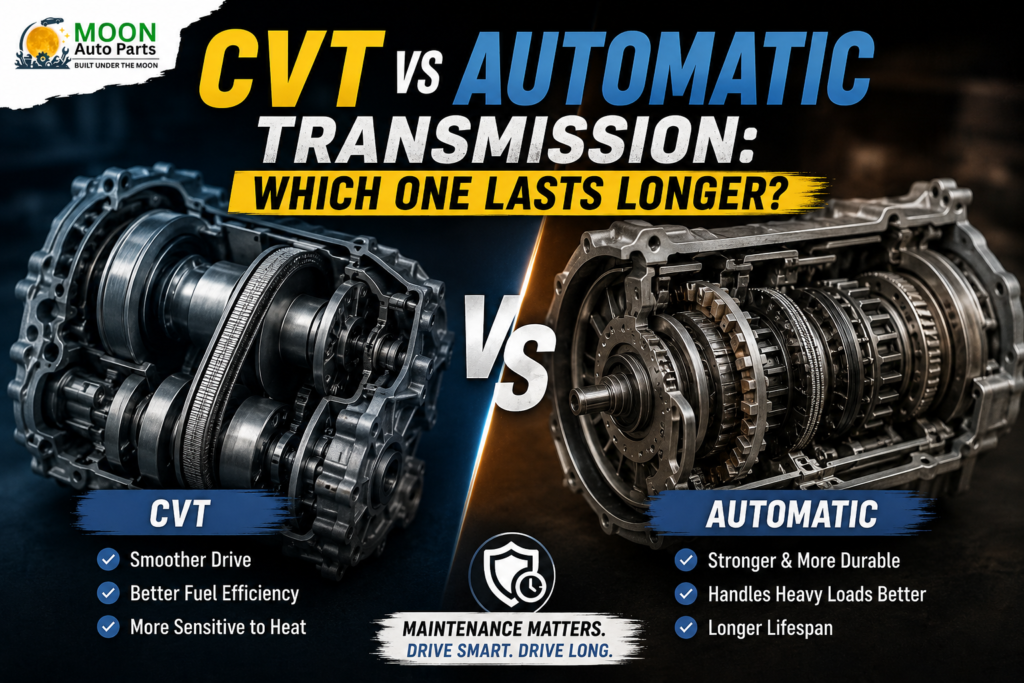
What Is a CVT Transmission?
A Continuously Variable Transmission (CVT) doesn’t use fixed gears like a traditional automatic. Instead, it uses a pair of variable-width pulleys connected by a steel belt or chain. By changing the diameter of those pulleys, the CVT continuously adjusts the gear ratio to keep the engine running at its most efficient RPM at all times.
The result is smooth, seamless acceleration with no detectable gear shifts. CVTs are especially common in smaller sedans and compact SUVs because of their fuel efficiency benefits. Models like the Nissan Altima, Honda HR-V, Subaru Forester, and Toyota Corolla all use CVTs as standard equipment.
What Is a Traditional Automatic Transmission?
A traditional automatic transmission uses a fixed set of gears — typically between 6 and 10 on modern vehicles — along with a torque converter to transfer power from the engine to the drivetrain. As speed increases, the transmission steps through these gears in sequence.
Automatic transmissions have been standard in American vehicles for decades. They’re found in everything from full-size trucks like the Ford F-150 and Chevy Silverado to family sedans and performance cars. Most drivers are very familiar with how they feel and behave.
CVT vs Automatic Transmission: Lifespan Comparison
This is the core question, and the honest answer is that traditional automatic transmissions generally last longer than CVTs — but the gap is closing as CVT technology improves.
Traditional Automatic Transmission Lifespan
A well-maintained automatic transmission can last between 150,000 and 200,000 miles, and some exceed that under the right conditions. Trucks and SUVs with heavy-duty automatics are well known for going well past 200,000 miles with regular fluid changes and care. Hard metal gears and a robust torque converter are built to handle significant stress without breaking down prematurely.
CVT Transmission Lifespan
CVTs have improved significantly since their early iterations, but they still typically average around 100,000 to 150,000 miles before major issues arise. The steel belt or chain that drives a CVT is under constant tension and generates considerable heat, causing wear that traditional gear sets simply don’t experience the same way.
Early CVT models from the mid-2000s had a rough reputation, with many failing well before 100,000 miles. Nissan CVTs in particular became notorious for premature failure, leading to class action lawsuits and extended warranty programs. Newer CVT designs have addressed many of these issues, but they still don’t match the longevity record of a solid traditional automatic in most real-world applications.
Why Do CVTs Fail Earlier?
Heat and Belt Wear
The continuously variable belt or chain in a CVT operates under constant load. Every time you accelerate, that belt flexes and grips the pulleys. Over hundreds of thousands of cycles, the belt stretches, the pulleys wear, and the fluid breaks down faster than in a traditional automatic.
Fluid Sensitivity
CVTs are extremely sensitive to transmission fluid condition. Running old or incorrect fluid causes CVT failure much faster than in a traditional automatic. Many CVT failures trace directly back to neglected fluid changes or the wrong fluid being used during service.
Cooling Limitations
CVTs generate more heat relative to their size, and many factory cooling systems aren’t sized generously enough to keep temperatures in the optimal range during sustained driving or towing. Heat is the number one enemy of any transmission, and CVTs run hotter under stress.
Why Do Traditional Automatics Last Longer?
Proven Mechanical Design
Traditional automatic transmissions have been refined over many decades. The engineering behind a modern 8-speed automatic is the product of generations of development and improvement. Hard gear sets, clutch packs, and torque converters used in today’s automatics are extraordinarily durable under normal driving conditions.
Better Suited for Demanding Use
If you tow trailers, haul heavy loads, or drive in stop-and-go traffic for long periods, a traditional automatic handles that stress far better than a CVT. CVTs are generally not recommended for towing because constant belt tension under sustained load accelerates wear dramatically.
Easier and Cheaper to Rebuild
When a traditional automatic fails, it’s often easier and more cost-effective to rebuild or replace with a quality used unit. Parts are widely available, the technology is well understood, and used automatic transmissions are plentiful. CVT repairs tend to be more expensive because parts are more specialized.
How to Make Either Transmission Last Longer
Regardless of which type of transmission your vehicle has, these habits will extend its lifespan significantly:
- Change the transmission fluid on schedule. For CVTs this is especially critical — always use the correct fluid type specified for your vehicle.
- Avoid aggressive acceleration from a stop. Both CVTs and automatics experience the most stress during hard launches.
- Don’t tow beyond your vehicle’s rated capacity. Overloading the transmission accelerates wear in any drivetrain.
- Let the engine warm up before pushing hard, especially in cold weather.
- Address small issues early. Slipping, shuddering, or delayed engagement are warning signs. Ignoring them almost always turns a manageable repair into a full replacement.
Do You Need a Replacement CVT or Automatic Transmission?
If your CVT or automatic transmission reaches the point of no return, replacing it with a quality used or remanufactured unit almost always saves more money than buying a new vehicle or paying dealership prices for a brand-new transmission.
At Moon Auto Parts, we carry a wide selection of used and remanufactured transmissions for both CVT and automatic applications, covering virtually every major make and model on the road across the United States. Every unit in our inventory goes through a detailed inspection process before listing, and each qualifying transmission is backed by our 4-year, 40,000-mile warranty — whichever comes first.
Here’s what you get when you shop with us:
- 4-Year / 40,000-Mile Warranty on qualifying transmissions
- Free shipping to commercial addresses across the USA
- No core charge — no hidden fees at checkout
- Thoroughly inspected inventory with documented mileage before listing
- VIN-verified compatibility to ensure the right unit every time
- Wide selection covering CVT and automatic transmissions for Honda, Nissan, Subaru, Toyota, Ford, Chevy, BMW, Mercedes-Benz, Jeep, and many more
- Knowledgeable support team at +1 (888) 777-0769, Monday through Friday, 9 AM to 7 PM CST
Final Thoughts
When it comes to CVT vs automatic transmission longevity, traditional automatics hold the edge — particularly for high-mileage use, towing, and demanding driving conditions. CVTs offer real fuel efficiency benefits and a smooth driving experience, but they require more careful maintenance and tend to have a shorter overall lifespan in real-world conditions.
Whatever type of transmission your vehicle has, the most important thing you can do is stay on top of fluid changes, address warning signs early, and work with a trusted supplier if a replacement ever becomes necessary.
Need a used or remanufactured transmission? Browse our full inventory or call our specialists at +1 (888) 777-0769 today.
Frequently Asked Questions
Which lasts longer, a CVT or an automatic transmission?
Traditional automatic transmissions generally last longer, typically between 150,000 and 200,000 miles with proper maintenance. CVTs average around 100,000 to 150,000 miles, though newer designs are improving that range.
Is a CVT transmission expensive to replace?
Yes. CVT replacements tend to cost more than traditional automatic replacements because the parts are more specialized and the technology is more complex. Buying a quality used or remanufactured CVT is the most affordable replacement option for most drivers.
Which is better for towing — CVT or automatic?
A traditional automatic transmission is far better suited for towing. CVTs are not designed for sustained heavy loads, and towing with a CVT can significantly shorten its lifespan.
How often should I change the fluid in a CVT transmission?
Most manufacturers recommend CVT fluid changes every 30,000 to 60,000 miles, but always check your owner’s manual. CVTs are extremely sensitive to fluid condition, and neglected fluid changes are one of the leading causes of early CVT failure.
Can I replace a CVT with a traditional automatic transmission?
In most modern vehicles this is not a practical swap due to differences in computer systems, drivetrain configuration, and mounting points. Replacing a failed CVT with a quality used or remanufactured CVT is the most straightforward solution.
Does Moon Auto Parts carry CVT transmissions?
Yes. Moon Auto Parts carries used and remanufactured CVT transmissions for a wide range of vehicles, including Honda, Nissan, Subaru, Toyota, and more, backed by a 4-year, 40,000-mile warranty.
What are the signs that a CVT transmission is failing?
Common warning signs include shuddering during acceleration, slipping between gear ratios, a burning smell, delayed engagement when shifting into drive or reverse, and unusual whining or humming noises from the transmission area.
Related Posts
What is Most Reliable Audi Engines to Buy?
Audi has built a reputation for delivering luxurious performance, quattro all-wheel drive, and cutting-edge technology but not all of its engines are created equal. For American buyers deciding between a used…
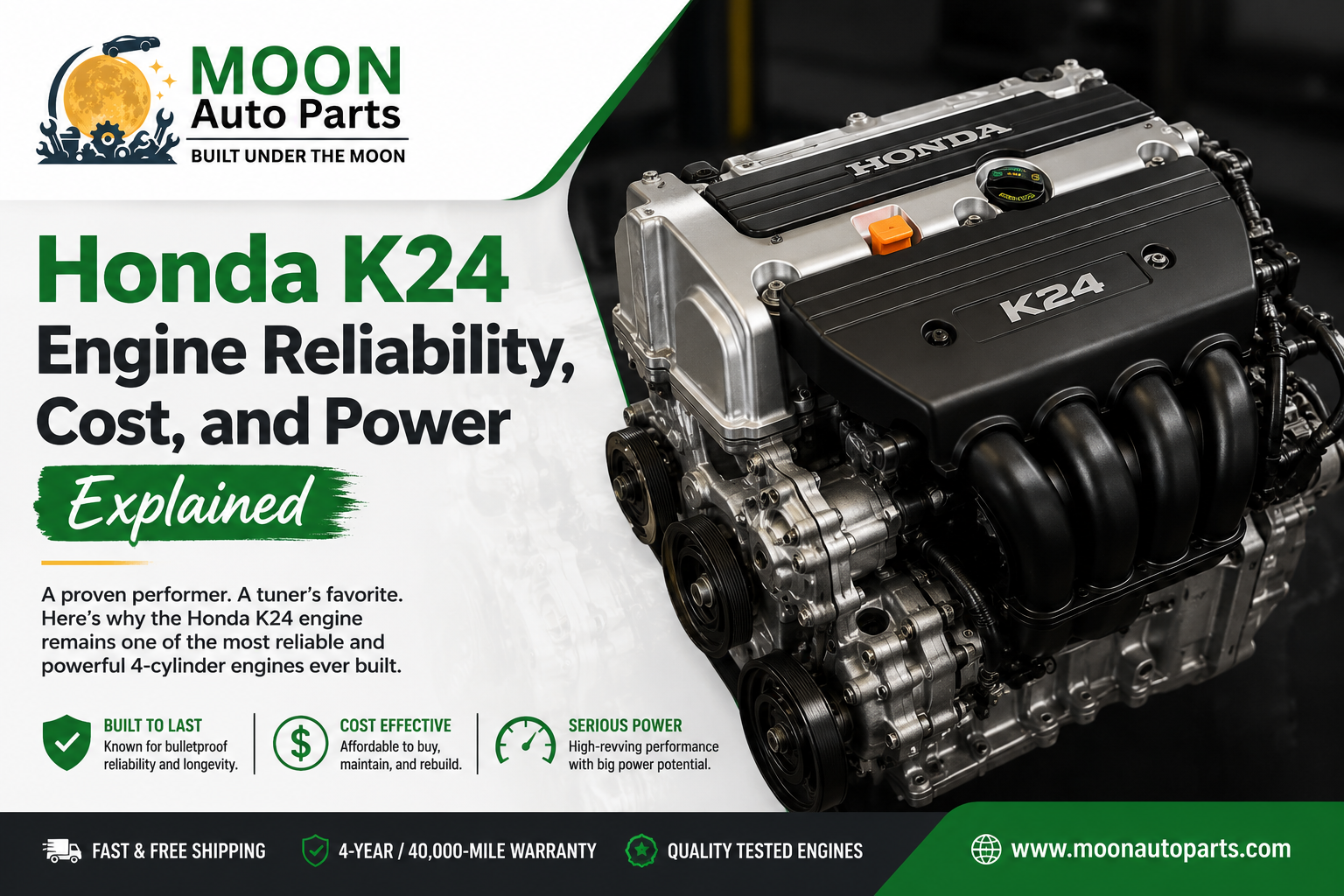
Honda K24 Engine Reliability, Cost, and Power Explained
The Honda K24 engine has earned a reputation as one of the most dependable and versatile four-cylinder engines ever built. Introduced in the early 2000s as part of Honda's K-Series…
Are Used Car Engines as Reliable as Remanufactured Engines?
When your car's engine calls it quits, the decision you face next can feel overwhelming and expensive. Do you go for a used engine pulled from a salvage yard, or…
How to Buy a Reliable Used Engine Online in 2026?
Engine failure is one of the most stressful repairs a vehicle owner faces. Within minutes of hearing the diagnosis your mind jumps straight to cost and for good reason. Dealer…