
Dodge V8 HEMI vs Ford 5.0 Coyote
American drivers have never really let go of the V8. Turbocharged six-cylinders and hybrid powertrains creep into more lineups every year. But the sound, the torque, and the simplicity of eight cylinders still keep buyers coming back. Two engines define that loyalty more than almost any other the Dodge engines v8 HEMI and the Ford 5.0 Coyote.
This guide is for anyone cross-shopping a Dodge Charger, Challenger, Durango, or Ram against a Ford Mustang or F-150. It’s also for anyone shopping for a replacement or rebuilt V8 engine who wants to decide which platform fits their driving needs, budget, and long-term plans.
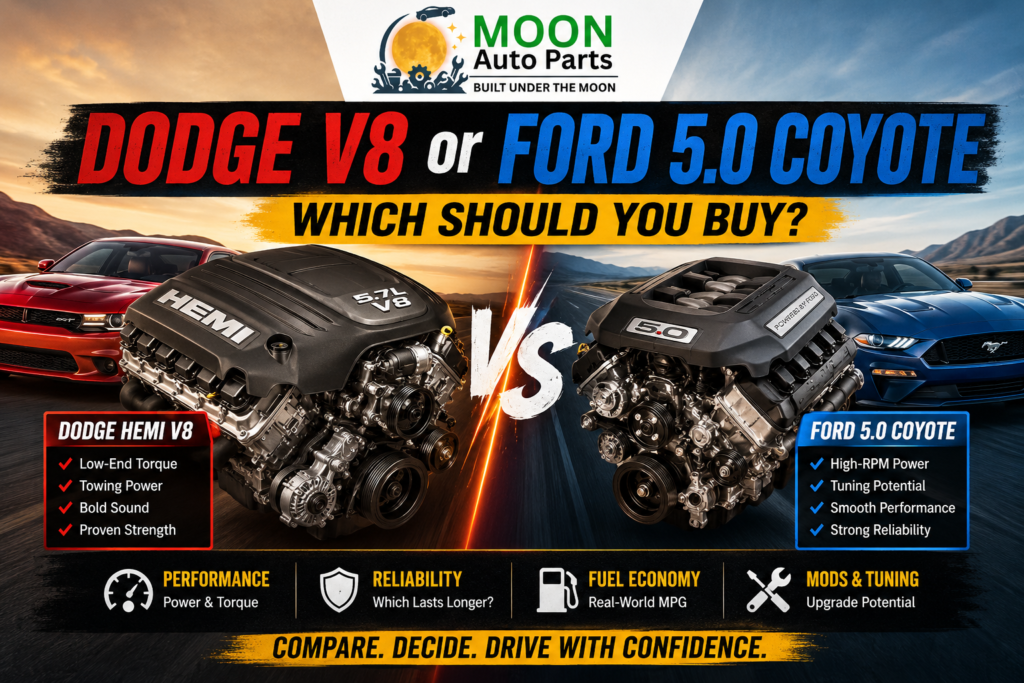
What Is the Difference Between a Dodge HEMI V8 and Ford 5.0 Coyote?
The core difference comes down to engineering philosophy. The HEMI uses a pushrod valvetrain with two valves per cylinder and a single camshaft. It prioritizes simplicity, low-end torque, and a deep, traditional V8 rumble. The Coyote uses a dual-overhead-cam design with four valves per cylinder, prioritizing high-RPM airflow and peak horsepower. Neither approach is objectively “better.” They’re built for different priorities.
What makes the Dodge HEMI engine unique?
The HEMI name refers to its hemispherical combustion chamber design. This layout dates back to Chrysler’s earliest V8s, and Chrysler revived it in 2003 for modern Dodge, Ram, and Chrysler vehicles. The 5.7L Hemi V8 marked the return of that hemispherical combustion chamber design in 2003, balancing iconic V8 power with modern technology. It has remained the standard V8 across countless Dodge, Ram, and Chrysler vehicles since. The engine uses a pushrod, two-valve-per-cylinder layout, which keeps the design relatively simple and compact compared to overhead-cam engines. The HEMI’s foundation is a 90-degree V8 with a pushrod valvetrain, though it didn’t stay static. The 2009 “Eagle” revision added variable valve timing and an improved Multi-Displacement System, and that change significantly boosted output, especially in flagship Ram trucks.
That MDS technology, along with the more recent eTorque mild-hybrid system, lets the HEMI shut down cylinders under light load to save fuel without sacrificing torque when you need it.
What makes the Ford 5.0 Coyote engine different?
The Coyote takes the opposite approach. It uses a dual-overhead-cam, 32-valve layout, which is fundamentally different from the HEMI’s single-cam, overhead-valve design. That extra valvetrain complexity lets the engine pull in more air at higher engine speeds. That’s part of why the Coyote tends to make its peak power further up the rev range than the HEMI.
The Coyote name traces back to Ford’s 302-cubic-inch small block heritage, but the modern version is a clean-sheet design. The 5.0 Coyote has deep roots dating to the late-1960s 302 cubic-inch V8. It returned to Ford’s lineup in the 2011 Mustang and has carried on through today’s performance models. You’ll mainly find it in the Mustang and select F-150 trims, a much narrower application than the HEMI’s spread across cars, trucks, and SUVs.
Which V8 produces more horsepower?
In their current forms, the two engines are closer than you might expect. Ford’s 5.0-liter Coyote V8 in the F-150 continues to put out 400 horsepower and 410 lb-ft of torque, mated to a 10-speed automatic transmission. The 5.7 HEMI, meanwhile, makes between 345 and 395 horsepower and 375 to 410 lb-ft of torque, depending on the model year and application.
In the Mustang, though, Ford has pushed the Coyote considerably further. The current iteration of the Coyote V8 is the most powerful version yet: the 2026 Mustang GT carries a 480-horsepower rating, or 486 hp with the optional performance exhaust. Step up to Dodge’s larger 6.4-liter “392” HEMI, and the comparison shifts again. That engine significantly outmuscles the 5.0 Coyote in raw displacement, using an overhead-valve, single-camshaft design versus the Coyote’s four overhead cams.
So the honest answer is: it depends which version of each engine you’re comparing. Truck-for-truck, the two are nearly dead even. Mustang-for-Challenger, the Coyote currently holds the horsepower edge unless you’re looking at the 392 HEMI.
Which engine sounds better on the road?
This one comes down to personal taste more than engineering. The HEMI’s pushrod design and larger displacement tend to give it a deeper, more traditional muscle car growl, the sound most people associate with classic American V8s. The Coyote’s higher-revving nature gives it a sharper, more mechanical, almost motorsport-like exhaust note as RPMs climb. Neither is wrong. It’s a matter of whether you want a low rumble or a high-revving snarl.
Which Engine Is More Reliable for Daily Driving?
Both engines have strong reputations for durability, and both can comfortably exceed 200,000 miles with proper maintenance. The differences show up more in how they age and what tends to fail first.
Is the Dodge HEMI reliable long term?
The HEMI’s simplicity works in its favor here. Most experts consider the 5.7L HEMI one of the most reliable Dodge engines v8 and Chrysler have ever built, and it remains a solid choice in 2026 for its balance of performance and reliability. With consistent maintenance, the engine can easily run 200,000 to 300,000 miles, as long as owners keep up with oil changes, spark plugs, and cooling system service.
How reliable is the Ford 5.0 Coyote engine?
The Coyote has earned its own strong reputation, including industry recognition. The Ford Coyote has won Wards’ Top 10 Best Engines award four times in the past decade, compared to once for the HEMI. That said, awards reflect engineering achievement more than long-term durability data. The Coyote’s added valvetrain complexity (four cams instead of one) does introduce more components that can eventually need attention, like timing chains, tensioners, and variable cam timing solenoids.
Common Dodge HEMI problems owners report
The Multi-Displacement System causes the most widely discussed HEMI issue. It can develop lifter or camshaft problems in some model years if owners neglect maintenance. Loose or broken exhaust manifold bolts come up often too, along with occasional oil consumption concerns in certain production years. None of these issues affect every engine, but they’re the items a buyer or technician should specifically inspect on a used HEMI.
Common Ford Coyote engine issues
Coyote owners most commonly report timing chain tensioner wear over very high mileage, occasional oil consumption on early generations, and spark plug or coil issues that can trigger misfires if you don’t address them proactively. Like the HEMI’s MDS lifters, these are known issues rather than guaranteed failures, and most stay manageable with routine maintenance.
Which V8 lasts longer with proper maintenance?
Realistically, both engines can go past 200,000 miles when you take care of them. The HEMI’s simpler architecture may make it marginally easier and cheaper to maintain over time. The Coyote’s more advanced design demands more precise service intervals but rewards owners who keep up with that maintenance. Neither engine holds a meaningful longevity advantage over the other when both get proper care.
Dodge HEMI or Ford Coyote Performance Comparison
Which engine is faster in stock form?
Acceleration depends heavily on the vehicle, not just the engine. In one well-known comparison, the Mustang’s Coyote 5.0 produced 412 horsepower compared to the Challenger’s HEMI 5.7 at 375 horsepower, despite the HEMI’s larger displacement. Real-world drag strip results, though, often tell a different story once vehicle weight enters the equation. Engine-to-engine, the larger 6.4 HEMI’s output figures outgun the Coyote by a significant margin. But in the real world, the heavier Challenger was at a disadvantage against the lighter Mustang GT, and their raw acceleration and quarter-mile figures ended up quite close.
In truck form, the gap closes even further. In a 2026 drag race between a Ram 1500 Warlock with the HEMI V8 and a Ford F-150 Tremor with the Coyote V8, the Ford ran a quarter-mile in 16.38 seconds at 89.3 mph, narrowly beating the Hemi-powered Ram by less than a truck length.
Which V8 has better towing capability?
The HEMI’s low-end torque and broader power band make it well-suited to towing, a goal Dodge engines v8 has always built into its design for Ram trucks. It’s worth noting, though, that the whole truck determines towing capacity — frame, axle ratios, cooling, and transmission — not the engine alone. Towing capacity depends on the entire vehicle, including its frame, axles, gearing, and cooling, not just the engine. Both the HEMI-equipped Ram and Coyote-equipped F-150 make capable tow vehicles when properly configured.
Which engine responds better to modifications?
This depends on what kind of power you’re chasing. The HEMI’s pushrod design and aftermarket familiarity make it a popular platform for cam swaps, headers, and supercharger kits, backed by a huge parts ecosystem built around two decades of production. The Coyote’s higher-flowing heads and stronger factory internals in later generations make it a favorite for forced-induction builds aiming at very high horsepower numbers, especially with Ford Performance’s extensive crate engine and parts catalog behind it.
Is the Ford Coyote better for high RPM performance?
Yes — this is where the Coyote’s DOHC design shows its purpose. The four-valve-per-cylinder layout pulls in more air at higher RPM. That’s why the Coyote tends to make peak power later in the rev range and feels noticeably different to drive than a HEMI when pushed hard. It’s also part of why it’s the preferred engine in Ford’s track-focused Mustang variants.
Does the Dodge HEMI deliver more low-end torque?
Generally, yes, particularly in truck applications. The 5.7L HEMI delivers excellent low-end torque for towing, which is one of its defining characteristics as a naturally aspirated V8. That low-RPM grunt is part of why it feels strong in daily driving and hauling situations, even when peak horsepower numbers are close to or slightly behind the Coyote.
Which V8 Engine Has Better Fuel Economy?
Does the Ford 5.0 get better gas mileage?
Not necessarily. Real-world results can actually favor the HEMI in some configurations. In one back-to-back fuel economy test, the eTorque mild-hybrid HEMI Ram returned 21.4 mpg over a 41.5-mile loop, while the Coyote-powered F-150 returned a less impressive 18.3 mpg. That’s a notable result given the HEMI’s reputation as the “thirstier” traditional V8. It shows how much eTorque hybrid assistance has closed the efficiency gap in recent years.
Is the Dodge HEMI expensive to maintain?
Routine maintenance — oil changes, spark plugs, coolant service — costs about the same as most other V8s, and isn’t considered expensive by truck or muscle car standards. Choosing the HEMI option typically adds about a $1,200 upcharge over the base engine, and buyers should expect a noticeable hit at the pump compared to smaller turbocharged alternatives. Compared to the Coyote specifically, though, ownership costs run broadly similar.
Which engine costs more to own yearly?
Total cost of ownership runs closer between these two than either fanbase tends to admit. Parts availability is excellent for both. Insurance costs track more with the vehicle than the engine. Fuel costs vary by driving style and configuration more than by engine choice alone. If anything distinguishes the two, the HEMI tends to have slightly lower-cost aftermarket parts thanks to its simpler architecture, while Coyote parts can run a bit higher given the more complex DOHC design.
Best V8 for highway driving in the U.S.
Both perform well at highway speeds, but the HEMI’s MDS cylinder deactivation and eTorque assistance give it an edge in steady-state highway cruising efficiency, especially in truck applications. The Coyote, meanwhile, tends to feel more composed and responsive during passing maneuvers thanks to its higher-revving nature, a trait that can matter more to performance-minded highway drivers.
Best Vehicles Using These Engines
Best Dodge cars and trucks with HEMI engines
The HEMI has powered a wide range of vehicles over its two-decade run, including the Ram 1500, Ram 2500/3500 heavy-duty trucks, Dodge Charger, Dodge Challenger, Dodge Durango, and various Jeep Grand Cherokee and Commander trims. For over two decades, the Hemi has powered millions of vehicles, from heavy-duty Ram 2500 trucks and Dodge Durangos to iconic muscle cars like the Dodge Charger R/T and Challenger R/T.
Popular Ford models using the 5.0 Coyote
The Coyote’s application list is narrower but no less iconic. You’ll find it in 2011-and-newer Mustangs and select upgraded F-150 pickup trucks, with the most powerful versions appearing in the Mustang Dark Horse and Dark Horse R.
Which used vehicles offer the best value?
Used HEMI-powered Ram trucks and older Charger/Challenger models tend to offer strong value, since manufacturers built so many of them and the used parts market runs deep. Used Coyote-powered Mustangs, particularly 2011-2017 models, draw enthusiasts looking for an affordable platform with serious modification potential. Either way, always get a pre-purchase inspection done and pull a full maintenance history before buying.
Best engine for muscle cars
For raw displacement and classic muscle car character, the HEMI (especially the 6.4-liter 392) is hard to beat. For high-revving, track-capable performance in a more modern package, the Coyote — particularly in Dark Horse trim is the stronger choice.
Best engine for pickup trucks
Both are proven truck engines. The HEMI has the longer truck pedigree and slightly better low-end torque characteristics for towing and hauling, while the Coyote in the F-150 offers comparable horsepower with a more modern valvetrain.
Dodge HEMI vs Ford Coyote for Modifications
Which engine is easier to upgrade?
The HEMI’s simpler pushrod architecture generally makes basic modifications (cold air intakes, exhaust, tunes, cam swaps) more straightforward and less expensive to execute. The Coyote’s DOHC design takes more work to modify, but it gives builders more sophisticated factory engineering to start from at the high end.
Best aftermarket support for V8 engines
Both engines benefit from massive aftermarket ecosystems. Mopar and various third-party manufacturers offer extensive HEMI support, from cold air intakes to forged internals and supercharger kits. Ford Performance backs the Coyote directly with factory crate engines, calibration tools, and a deep catalog of performance parts, giving Coyote builders strong factory-level support.
Turbo vs supercharger setups
Superchargers work naturally with the HEMI because of its strong low-end torque. They enhance the engine’s existing power delivery and improve acceleration.
Turbo setups are especially popular on the Ford 5.0 Coyote. The engine’s strong factory internals and high-RPM design make it ideal for big horsepower builds. Later Coyote generations can handle even more power thanks to upgraded factory components.
Which engine handles more horsepower safely?
Builders often point to later-generation Coyote engines (Gen 3 and newer) as having stronger factory internals capable of handling significant boost before needing forged components. The HEMI can also handle considerable power increases, but builders chasing very high horsepower numbers on either engine will eventually need forged pistons, rods, and supporting fuel system upgrades, regardless of which platform they choose.
Best V8 for drag racing enthusiasts
Both have a strong presence at the drag strip. The Coyote tends to favor high-RPM, naturally aspirated or turbocharged builds optimized for top-end power. The HEMI’s torque characteristics make it a favorite for builders prioritizing low-RPM launch power, particularly in supercharged configurations.
Which Engine Should You Buy in 2026?
Best choice for reliability
The HEMI’s simpler design and two decades of refinement make it a slightly easier engine to maintain long-term, though both engines are capable of high-mileage reliability with proper care.
Best option for performance lovers
If you want a high-revving and track-ready engine, the Ford Coyote is a strong choice. It delivers impressive factory horsepower, especially in the current Mustang GT and Dark Horse models. The 2026 Mustang GT Coyote produces 480 horsepower. With the optional performance exhaust, output increases to 486 horsepower. This makes it the most powerful factory Coyote engine Ford has produced so far.
Best V8 for budget buyers
Used HEMI-powered trucks and sedans tend to run more widely available, and often more affordable, than comparable Coyote-powered Mustangs. That’s simply because manufacturers built a larger volume of HEMI vehicles across more model lines.
Which engine has better resale value?
Coyote-powered Mustangs, particularly performance trims like the GT and Dark Horse, tend to hold strong resale value thanks to enthusiast demand. HEMI-powered trucks also hold value well, especially now that the engine has returned to the Ram 1500 lineup after Stellantis briefly discontinued it. The replacement Hurricane inline-six is objectively more powerful and more fuel-efficient. But buyers reacted strongly enough against losing the V8 that Ram brought the 5.7L Hemi back for the 2026 model year, and Ram’s CEO publicly acknowledged the decision to drop it had been a mistake. That kind of demand tends to support resale value over time.
Final recommendation based on driving needs
If you tow regularly, want low-end torque, or value mechanical simplicity, the HEMI is the better fit. If you want a high-revving, modern performance engine with strong factory power and a deep motorsport-oriented aftermarket, the Coyote is the better choice. For most daily truck owners, the two are close enough that vehicle preference should probably decide the purchase, not the engine alone.
FAQ
Is the Dodge HEMI better than the Ford 5.0 Coyote?
Neither is universally “better.” The HEMI offers stronger low-end torque, mechanical simplicity, and a traditional V8 sound, while the Coyote offers higher peak horsepower, a modern DOHC design, and stronger high-RPM performance. The right choice depends on your driving priorities.
Which V8 engine lasts longer?
Both engines can exceed 200,000 to 300,000 miles with consistent maintenance. Neither holds a clear, well-documented longevity advantage over the other when you care for it properly.
What is the most reliable Dodge V8 engine?
Most experts regard the 5.7L HEMI as one of the most reliable V8 engines Dodge and Chrysler have produced, particularly when owners keep oil changes, spark plugs, and cooling system service current.
Is the Ford 5.0 Coyote good for tuning?
Yes. The Coyote has strong factory internals in later generations and extensive support from Ford Performance, making it a popular platform for both naturally aspirated and forced-induction builds.
Conclusion
Both the Dodge HEMI and Ford 5.0 Coyote are proven, well-supported V8 engines with loyal followings for good reason. The HEMI brings simplicity, low-end torque, and a classic V8 character. It has powered everything from work trucks to muscle cars for over two decades. The Coyote brings modern DOHC engineering, higher peak horsepower, and a motorsport-driven aftermarket built around chasing RPM.
If you tow often or want an engine that is easier to maintain and modify, the HEMI is a strong choice. It delivers solid low-end torque and works well for trucks and heavy-duty use. If you prefer high-revving performance and strong aftermarket tuning support, the Ford 5.0 Coyote stands out. It is popular among performance enthusiasts and muscle car fans. No matter which V8 you choose, consider the vehicle, your driving style, and your long-term plans before making a decision.
Before buying a used Dodge or Ford V8, compare mileage, maintenance records, and accident history carefully. Also check for any remaining factory or extended warranty coverage. A professional inspection can help you avoid expensive engine problems later.. A few hours of due diligence up front can save thousands in repair costs down the road. It’s the best way to make sure whichever V8 you choose lives up to its reputation.
Related Posts

How to Find a Reliable Used Engine Near Me?
When your engine gives out, the first instinct for most car owners is to search "used engine near me" and hope for the best. But finding a reliable used engine…
Why Do Most People in the USA Choose Moon Auto Parts for Replacement Engines and Transmissions?
When a vehicle engine fails or a transmission begins to slip, many drivers immediately worry about the high cost of repairs. Replacing an engine or transmission through a dealership can…
How to Buy a Reliable Used Engine Online in 2026?
Engine failure is one of the most stressful repairs a vehicle owner faces. Within minutes of hearing the diagnosis your mind jumps straight to cost and for good reason. Dealer…
Used Transmission vs Rebuilt Transmission: Complete Buyer’s Guide for 2026
Used Transmission vs Rebuilt Transmission When your transmission starts acting up, every mile you drive feels like a gamble. Whether it's slipping out of gear, shuddering at highway speeds, or…